Thread Lift in Myeongdong Seoul
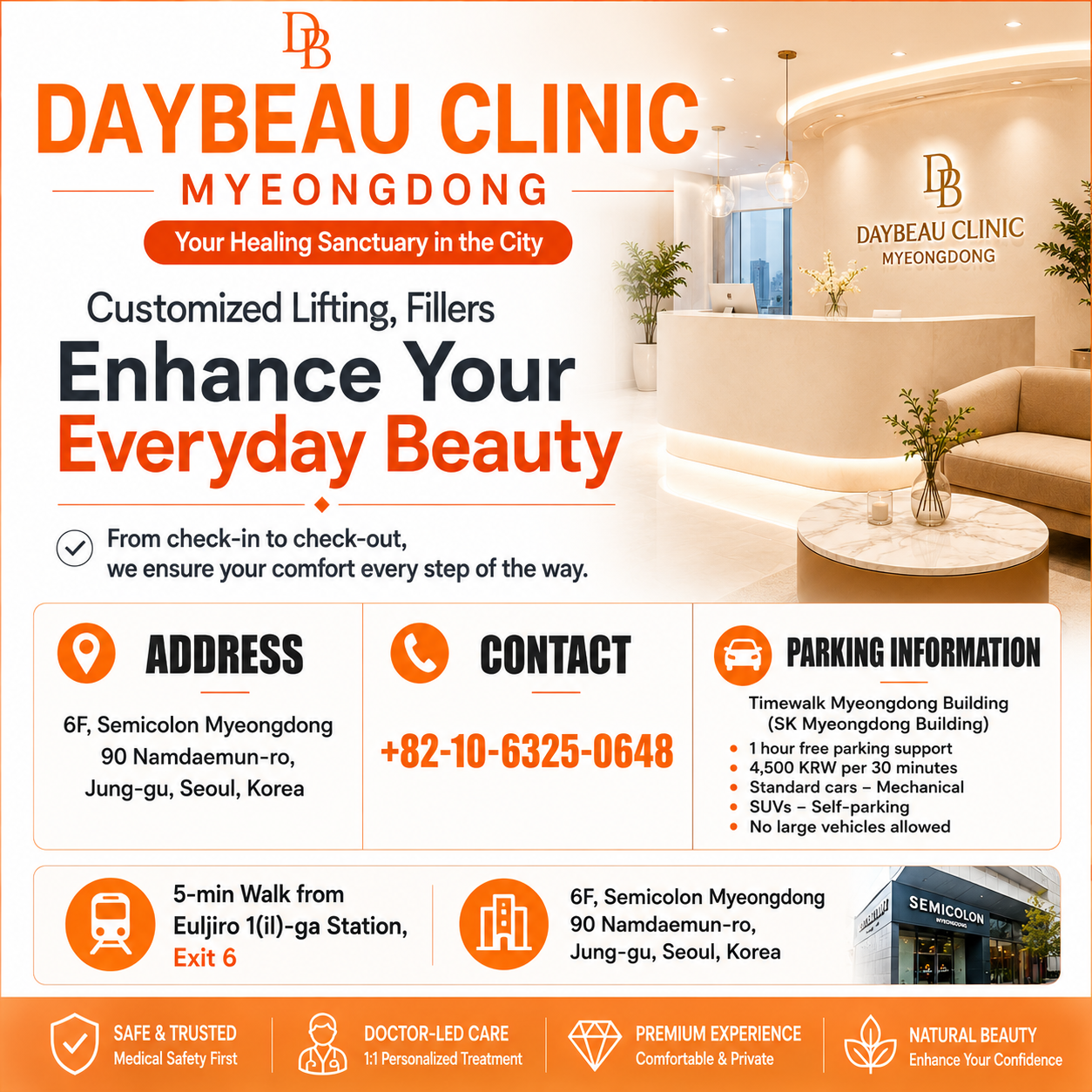
Myeongdong Daybeau Premium Branch
Discover Thread Lift treatments in Myeongdong, Seoul at Myeongdong Daybeau Premium Branch.
A thread lift uses absorbable medical threads placed beneath the skin to provide mechanical support and reposition selected
facial tissues, helping improve sagging cheeks, jowls, jawline definition, and overall facial contours without traditional facelift surgery.
What Is a Thread Lift?
A thread lift is a minimally invasive aesthetic procedure that uses absorbable threads inserted beneath the skin.
Depending on the type of thread and treatment technique, the threads can provide physical support to selected facial tissues and create a lifting effect.
Thread lifting is commonly considered by patients who want more visible lifting than many skin-quality treatments but do not yet want surgical facelift surgery.
What Can a Thread Lift Improve?
Thread lifting may be considered for concerns such as:
- Sagging cheeks
- Early jowls
- Undefined jawline
- Lower-face sagging
- Mild to moderate facial laxity
- Loss of facial definition
- Reduced skin firmness
- Aging facial contours
- Mild midface descent
- Early signs of facial aging
The appropriate treatment depends on the patient's facial anatomy and degree of tissue laxity.
How Does a Thread Lift Work?
During a thread lift, absorbable medical threads are carefully positioned beneath the skin.
Specialized threads can engage the surrounding tissue and provide mechanical support, allowing selected areas to be repositioned in a more lifted direction.
As the threads gradually dissolve, the treatment can also stimulate a tissue response around the treated areas.
The number, direction, and placement of threads should be customized according to facial anatomy rather than following the same pattern for every patient.
Thread Lift for Facial Lifting
Facial aging involves more than skin changes alone.
Collagen loss, changes in facial fat, reduced ligament support, and gravity can gradually cause facial tissues to descend.
Thread lifting can provide mechanical repositioning for selected patients, making it different from energy-based treatments that primarily rely on collagen remodeling.
Thread Lift for Sagging Cheeks
Sagging cheeks can make the midface appear heavier and contribute to lower-face aging.
Threads may be positioned to support and reposition selected cheek tissues, helping create a more lifted facial appearance.
Patients with significant volume loss may require additional treatment rather than lifting alone.
Thread Lift for Jowls
Early jowls are one of the most common reasons patients consider thread lifting.
Threads can be strategically positioned to improve support around the lower face and reduce the appearance of mild tissue descent.
Advanced jowling or substantial excess skin may require surgical lifting for a more significant correction.
Thread Lift for the Jawline
Loss of jawline definition can result from sagging skin, tissue descent, facial fat, or a combination of factors.
Thread lifting may help reposition lax tissue and create a cleaner transition between the lower face and jawline.
When excess fat contributes significantly to a heavy lower face, additional contouring treatment may be considered.
Thread Lift for the Midface
Age-related tissue descent can cause the cheeks and midface to appear flatter or lower.
Thread lifting may be considered for selected patients who want mechanical support and repositioning of the midface.
However, patients with significant volume depletion may also require treatment for volume loss to achieve balanced rejuvenation.
Thread Lift for a V-Line Face
Thread lifting is sometimes incorporated into Korean V-line facial contouring programs.
By repositioning selected lower-face tissues, treatment may create a more defined and streamlined appearance.
The result depends heavily on facial anatomy. Patients with excess facial fat, a wide jaw muscle, or skeletal width may require different contouring treatments.
Thread Lift vs HIFU Lifting
Thread lifting and HIFU work through different mechanisms.
Thread lifting mechanically supports and repositions tissue, while HIFU uses focused ultrasound energy to stimulate collagen remodeling at targeted tissue depths.
Patients seeking more immediate mechanical repositioning may consider threads, while those seeking completely non-invasive lifting may prefer HIFU treatments such as Ultherapy Prime or Shurink Universe.
Thread Lift vs Thermage FLX
Thermage FLX uses monopolar radiofrequency energy to improve skin firmness and stimulate collagen remodeling.
A thread lift uses absorbable threads to physically support and reposition selected tissues.
Thermage may be more appropriate when generalized skin laxity and reduced firmness are primary concerns, while thread lifting may be considered when tissue repositioning is desired.
Thread Lift vs Ultherapy Prime
Ultherapy Prime uses microfocused ultrasound with real-time visualization for non-invasive lifting and collagen stimulation.
Thread lifting is minimally invasive and involves physically placing threads beneath the skin.
The better option depends on degree of sagging, facial anatomy, desired lifting effect, downtime preference, and whether the patient wants an invasive or non-invasive procedure.
Thread Lift vs RF Lifting
RF treatments such as Thermage FLX, XERF, and Oligio use controlled heat to promote skin tightening and collagen remodeling.
Thread lifting works differently by providing mechanical support beneath the skin.
For selected patients, RF tightening and thread lifting may address different components of facial aging.
Thread Lift vs Dermal Filler
Threads and fillers serve different purposes.
Dermal fillers are generally used to restore volume, enhance contours, or support areas affected by volume loss.
Thread lifting is primarily intended to reposition selected sagging tissues.
Patients experiencing both tissue descent and facial volume loss may require a carefully planned combination approach.
Thread Lift vs Surgical Facelift
A thread lift is not a substitute for a surgical facelift.
Thread lifting is generally more appropriate for mild to moderate facial laxity, while surgical facelift procedures can address more significant tissue descent and excess skin.
The advantage of thread lifting is that it is less invasive and generally involves a shorter recovery period than facial surgery.
What Types of Threads Are Used for Thread Lifting?
Different absorbable thread materials and designs are available for aesthetic procedures.
Depending on the treatment system, threads may use materials such as PDO, PLLA, or PCL and may have different shapes, lengths, and tissue-engaging structures.
The appropriate thread should be selected according to the treatment area, tissue characteristics, and desired lifting effect.
PDO Thread Lift
PDO, or polydioxanone, is a commonly used absorbable medical thread material.
PDO threads are available in different designs and can be used for facial support, contouring, and collagen-related tissue response.
Not every PDO thread provides the same lifting strength, so thread design and placement technique are important.
How Many Threads Do I Need?
There is no universal number of threads required for a successful thread lift.
The appropriate number depends on:
- Degree of sagging
- Facial size
- Treatment area
- Tissue thickness
- Direction of tissue descent
- Type of thread
- Desired degree of correction
A larger number of threads does not automatically produce a better or more natural result.
When Will I See Thread Lift Results?
Because threads provide mechanical support, some lifting effect may be noticeable soon after treatment.
The appearance can continue to change as temporary swelling settles and the surrounding tissue adapts.
Final results vary according to the type of thread, treatment technique, facial anatomy, and individual healing response.
How Long Does a Thread Lift Last?
Thread lift longevity varies considerably between patients.
Factors include the thread material, number and placement of threads, facial anatomy, skin condition, degree of sagging, metabolism, and natural aging.
Because absorbable threads gradually dissolve, thread lifting should not be considered permanent.
Is Thread Lifting Painful?
Local anesthetic is commonly used to improve comfort during thread placement.
Patients may still experience pressure, pulling, or temporary discomfort during or after treatment.
Sensitivity varies between individuals and according to the number and location of threads used.
Is There Downtime After a Thread Lift?
Thread lifting generally involves more recovery than completely non-invasive lifting treatments.
Temporary effects can include:
- Swelling
- Bruising
- Tenderness
- Tightness
- Temporary dimpling or irregularity
- Discomfort with facial movement
Patients should follow the clinic's aftercare instructions carefully and consider recovery time when planning treatment during a trip to Seoul.
Thread Lift Aftercare
Post-treatment instructions vary according to the thread technique and treatment area.
Patients may be advised to temporarily avoid excessive facial movement, strong facial massage, pressure on treated areas, strenuous exercise, and certain aesthetic treatments.
Sleeping position and diet may also require temporary modification depending on the treatment plan.
Always follow the specific aftercare instructions provided by the treating medical team.
Can Thread Lifting Be Combined With Skin Boosters?
Yes, depending on treatment timing.
Treatments such as Rejuran, Rejuran HB, Juvelook, or SKINVIVE may be considered when patients want to improve hydration, texture, fine lines, or overall skin quality in addition to lifting.
The procedures should be appropriately sequenced to avoid unnecessary manipulation of newly placed threads.
Can Thread Lifting Be Combined With Collagen Stimulators?
Patients with both tissue descent and facial volume loss may potentially benefit from combining thread lifting with collagen-stimulating treatments.
Options such as Sculptra or Juvelook Volume address different aspects of facial aging.
Treatment areas, injection planes, and timing should be carefully planned.
Can Thread Lifting Be Combined With Ultherapy or Thermage?
Energy-based lifting and thread lifting may be used within the same overall anti-aging strategy for selected patients.
However, timing is important because ultrasound or RF energy should not be applied indiscriminately around recently placed threads.
The medical team should determine the appropriate order and interval between treatments.
Thread Lift for Patients in Their 30s
Patients in their 30s may consider thread lifting when early tissue descent or lower-face laxity becomes noticeable.
A conservative approach may be appropriate when the goal is subtle contour improvement rather than dramatic lifting.
Thread Lift for Patients in Their 40s and 50s
Patients in their 40s and 50s may experience more noticeable cheek descent, jowling, and reduced jawline definition.
Thread lifting may be considered when laxity remains within a range suitable for minimally invasive correction.
More advanced sagging may require a combination approach or surgical evaluation.
Thread Lift in Myeongdong for Foreigners
Myeongdong is a convenient location for international patients seeking Korean facial lifting and anti-aging treatments during a trip to Seoul.
Myeongdong Daybeau Premium Branch is accessible for travelers staying around Myeongdong, Euljiro, Jongno, City Hall, Seoul Station, and central Seoul.
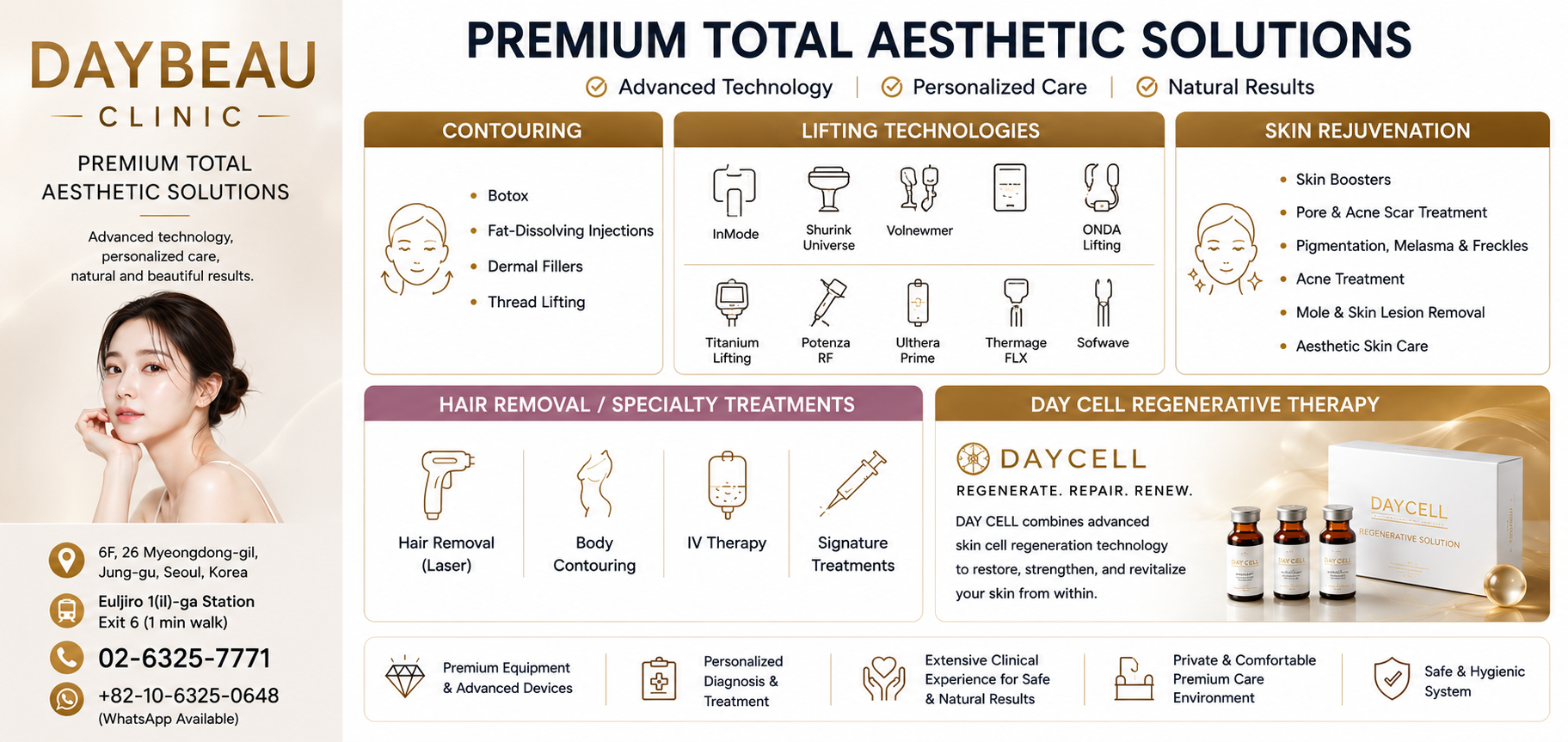
International patients can receive an individualized consultation to determine whether thread lifting, Ultherapy Prime, Thermage FLX, XERF, Oligio, Shurink Universe, or another treatment better matches their degree of facial laxity.
Why Choose Myeongdong Daybeau Premium Branch for Thread Lift?
Successful thread lifting depends heavily on selecting appropriate patients and creating a treatment plan based on individual facial anatomy.
At Myeongdong Daybeau Premium Branch, treatment planning can consider facial proportions, skin thickness, tissue descent, degree of jowling, jawline definition, volume distribution, and desired lifting direction.
The goal is to achieve balanced facial rejuvenation rather than simply inserting the highest possible number of threads.
FAQs About Thread Lift in Myeongdong
What is a thread lift?
A thread lift is a minimally invasive aesthetic procedure that uses absorbable threads placed beneath the skin to support and reposition selected facial tissues.
What areas can a thread lift treat?
Common areas may include the cheeks, midface, lower face, jowls, and jawline depending on individual anatomy and the thread system used.
Is a thread lift good for jowls?
Thread lifting may help improve early to moderate jowling by providing mechanical support to selected lower-face tissues. Advanced jowls may require surgical evaluation.
Does a thread lift improve the jawline?
It may improve jawline definition when tissue laxity and descent contribute to an undefined lower face.
Which is better, thread lift or Ultherapy?
Neither is universally better. Thread lifting provides mechanical tissue support, while Ultherapy uses focused ultrasound for non-invasive collagen remodeling and lifting.
Which is better, thread lift or Thermage?
They have different purposes. Thread lifting repositions selected tissue, while Thermage uses RF energy primarily for skin tightening and collagen remodeling.
How many threads do I need for a face lift?
The number varies according to facial anatomy, treatment area, degree of sagging, thread type, and desired result. More threads do not automatically mean a better result.
How long does a thread lift last?
Longevity varies according to thread material, technique, anatomy, skin condition, lifestyle, and natural aging. Absorbable thread lifting is not permanent.
Is there downtime after a thread lift?
Some downtime should be expected. Temporary swelling, bruising, tenderness, tightness, or skin irregularity can occur following treatment.
Can foreigners get a thread lift in Myeongdong?
Yes. International patients visiting Seoul can receive consultation and customized thread lift treatment planning at Myeongdong Daybeau Premium Branch.
Visit Myeongdong Daybeau Premium Branch
Address
Myeongdong Daybeau Premium Branch
90 Namdaemun-ro, Jung-gu, Seoul 04534, South Korea
WhatsApp
+82-10-6325-0648