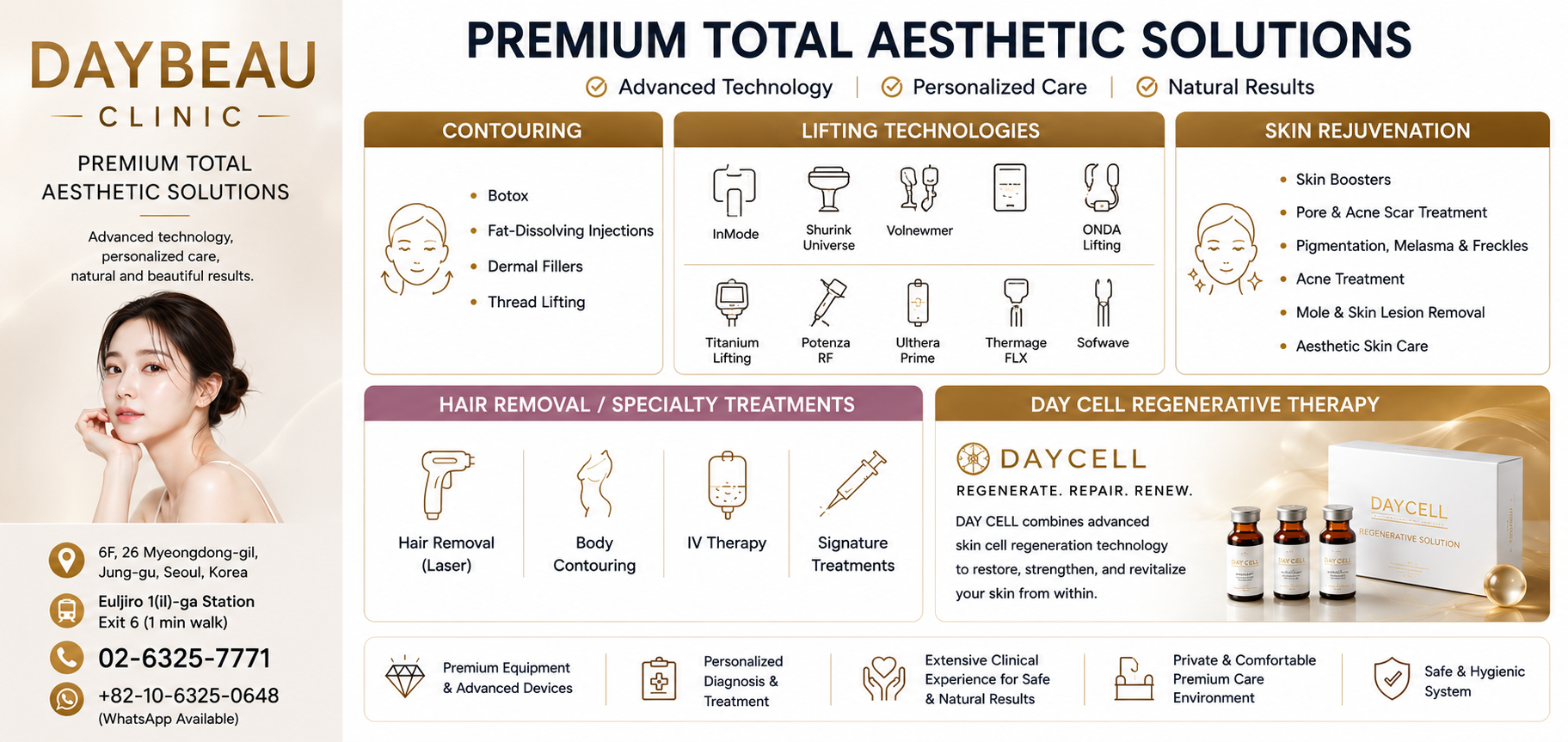
Nasolabial Fold Treatment in Myeongdong Seoul
Myeongdong Daybeau Premium Branch
Discover Nasolabial Fold Treatments in Myeongdong, Seoul at Myeongdong Daybeau Premium Branch.
Depending on what causes the folds, treatment may involve dermal fillers, collagen stimulators, skin boosters, RF tightening, HIFU lifting, or combination treatment to soften deep smile lines, restore facial support, and create smoother, more youthful-looking facial contours.
What Are Nasolabial Folds?
Nasolabial folds are the natural lines extending from each side of the nose toward the corners of the mouth.
Everyone has some degree of nasolabial folding, particularly when smiling. However, these folds can become deeper and more visible at rest as facial aging progresses.
Changes in facial volume, cheek support, collagen, skin elasticity, and tissue position can all contribute to increasingly prominent nasolabial folds.
What Causes Deep Nasolabial Folds?
Deep smile lines usually result from multiple anatomical factors rather than a single wrinkle.
Common contributors include:
- Midface volume loss
- Cheek tissue descent
- Collagen loss
- Reduced skin elasticity
- Facial anatomy
- Changes in facial fat
- Natural aging
- Genetics
- Sun exposure
- Repetitive facial movement
- Changes in structural facial support
Because the causes vary, the same treatment should not be used for every patient.
How Are Nasolabial Folds Treated?
Treatment should be selected according to why the nasolabial fold has become prominent.
Options may include:
- Hyaluronic acid filler
- Midface or cheek filler
- Collagen stimulators
- Sculptra
- Juvelook Volume
- Skin boosters
- Ultherapy Prime
- Thermage FLX
- XERF RF
- Oligio RF
- Shurink Universe
- Customized combination treatment
Some patients primarily need volume support, while others may benefit more from lifting or collagen-focused treatment.
Nasolabial Fold Filler
Hyaluronic acid filler is commonly used to soften nasolabial folds.
Carefully placed filler can provide structural support and reduce the appearance of deeper folds.
However, completely filling the crease is not always the best strategy.
Overcorrection can create heaviness around the mouth and midface, so treatment should preserve natural facial movement and proportions.
Direct vs Indirect Nasolabial Fold Filler
Nasolabial folds can sometimes be treated directly, indirectly, or using a combination of both approaches.
Direct treatment places filler strategically around the fold itself.
Indirect treatment restores support in areas such as the midface or cheek when volume loss or tissue descent is contributing to the fold.
The appropriate approach depends on individual facial anatomy.
Cheek Filler for Nasolabial Folds
A deep nasolabial fold does not necessarily mean that all filler should be placed directly into the smile line.
Age-related volume loss and changes in cheek support can make the fold appear deeper.
In selected patients, restoring midface support may soften the nasolabial fold while creating a more balanced facial rejuvenation.
Collagen Stimulators for Nasolabial Folds
Collagen stimulators may be considered when broader collagen and volume changes contribute to facial aging.
Treatments such as Sculptra or Juvelook Volume may help improve structural support progressively rather than simply filling a single wrinkle.
They may be particularly relevant for patients experiencing multiple signs of facial aging.
Sculptra for Nasolabial Folds
Sculptra is a PLLA collagen-stimulating injectable.
Rather than functioning only as an immediate wrinkle filler, it is designed to stimulate gradual collagen production.
For selected patients with age-related facial volume and collagen loss, Sculptra may help improve the broader facial changes that make nasolabial folds appear deeper.
Juvelook Volume for Nasolabial Folds
Juvelook Volume may be considered when collagen loss and reduced facial support contribute to prominent smile lines.
Treatment can be planned according to midface anatomy, volume distribution, and surrounding areas rather than simply targeting the crease itself.
Results and suitability vary between patients.
Skin Boosters for Nasolabial Folds
Skin boosters are generally intended to improve hydration, texture, elasticity, fine lines, and overall skin quality.
Treatments such as Rejuran, Rejuran HB, Juvelook, or SKINVIVE may complement nasolabial fold treatment when the surrounding skin also shows signs of aging.
Skin boosters alone are generally not intended to replace structural support when folds are deep.
Ultherapy Prime for Nasolabial Folds
Ultherapy Prime uses microfocused ultrasound to target selected tissue depths and stimulate collagen remodeling.
It may be considered when midface or lower-face laxity contributes to deeper-looking smile lines.
Rather than directly filling the fold, ultrasound lifting can address some of the tissue laxity surrounding it.
Thermage FLX for Nasolabial Folds
Thermage FLX uses monopolar radiofrequency energy for collagen remodeling and skin tightening.
It may help when reduced skin firmness contributes to more prominent facial folds.
Patients with significant structural volume loss may require additional injectable treatment for a more comprehensive result.
XERF RF for Nasolabial Folds
XERF uses monopolar RF technology to deliver controlled thermal energy at different tissue depths.
It may be incorporated into a treatment plan when nasolabial folds occur alongside reduced skin firmness, facial laxity, and broader signs of aging.
RF tightening does not directly replace lost facial volume.
Oligio RF for Nasolabial Folds
Oligio is a Korean monopolar RF treatment designed to improve skin firmness through thermal collagen remodeling.
For patients with mild laxity around the cheeks and lower face, improving overall firmness may help soften the appearance of facial folds.
Deeper nasolabial folds may require additional structural treatment.
Shurink Universe for Smile Lines
Shurink Universe uses focused ultrasound to target selected tissue depths.
It may be considered when cheek or lower-face tissue descent contributes to prominent smile lines.
HIFU works through collagen remodeling and lifting rather than directly filling the nasolabial crease.
Nasolabial Folds and Midface Volume Loss
Midface volume plays an important role in the appearance of nasolabial folds.
As facial support changes with age, cheek tissue can descend and place greater visual emphasis on the fold between the nose and mouth.
For these patients, addressing midface support and overall facial balance may be more effective than focusing only on the visible line.
Nasolabial Folds and Sagging Cheeks
Cheek descent can make nasolabial folds appear deeper.
When laxity is an important contributor, treatments focused exclusively on adding volume may not address the entire problem.
RF or HIFU lifting may therefore be considered alongside or instead of injectable treatment depending on facial anatomy.
Nasolabial Folds and Skin Laxity
Reduced elasticity allows facial tissues to move downward more easily with age.
If laxity is contributing significantly to smile lines, treatments such as Thermage FLX, Ultherapy Prime, XERF, Oligio, or Shurink Universe may be considered.
The goal is to improve surrounding support rather than simply erase a natural facial fold.
Nasolabial Folds vs Marionette Lines
Nasolabial folds and marionette lines are often confused.
Nasolabial folds extend from the sides of the nose toward the corners of the mouth.
Marionette lines extend downward from the corners of the mouth toward the chin and jawline.
Both can become more noticeable with aging, but they involve different anatomical areas and may require different treatment strategies.
Nasolabial Fold Treatment in Your 30s
Younger patients can have prominent nasolabial folds because of genetics, facial structure, cheek volume, or natural facial movement.
Conservative treatment is especially important in younger patients because nasolabial folds are a normal part of facial anatomy.
The goal should be softening excessive depth rather than eliminating all movement.
Nasolabial Fold Treatment in Your 40s and 50s
During the 40s and 50s, smile lines may become deeper because of combined collagen loss, midface volume changes, and tissue descent.
A combination of structural support and skin tightening may therefore provide a more balanced strategy than treating the crease alone.
Nasolabial Fold Treatment in Your 60s
In older patients, deeper folds may occur together with cheek descent, jowling, skin laxity, and more significant facial volume loss.
Non-surgical treatments can improve selected concerns, but expectations should be realistic when advanced facial sagging is present.
Nasolabial Fold Filler vs Skin Lifting
Filler and lifting treatments address different components of facial aging.
Filler can provide volume and structural support.
RF and HIFU treatments focus more on laxity and collagen remodeling.
Patients with both volume loss and sagging may benefit from a carefully planned combination.
Nasolabial Fold Filler vs Sculptra
Hyaluronic acid filler can provide relatively immediate structural correction.
Sculptra works differently by stimulating gradual collagen production.
The appropriate option depends on fold depth, facial volume, skin condition, desired timeline, and broader facial aging pattern.
Nasolabial Fold Treatment vs Thread Lift
Thread lifting provides mechanical support and repositioning of selected facial tissues.
Filler restores volume, while RF and HIFU stimulate tightening through energy-based treatment.
Thread lifting may be considered when tissue descent is a significant contributor, although it is not appropriate for every patient.
Nasolabial Fold Treatment vs Facelift
Non-surgical treatments can improve mild to moderate folds and associated volume or skin-quality concerns.
However, advanced cheek descent and facial laxity cannot always be corrected adequately with fillers or energy-based treatments.
Patients seeking substantial tissue repositioning may require surgical evaluation.
Can Nasolabial Fold Treatments Be Combined?
Yes. Nasolabial folds frequently result from several aging processes occurring simultaneously.
A personalized strategy may combine:
- Filler for structural support
- Midface treatment
- Collagen stimulators
- RF tightening
- HIFU lifting
- Skin boosters
The objective should be balanced facial rejuvenation, not simply injecting as much filler as possible into the visible crease.
How Much Filler Is Needed for Nasolabial Folds?
There is no standard amount suitable for every patient.
The amount depends on fold depth, facial anatomy, age, midface support, existing volume, skin laxity, and the filler selected.
More filler does not necessarily produce a better result.
When Will I See Nasolabial Fold Treatment Results?
The timeline depends on the treatment selected.
Hyaluronic acid fillers generally provide visible structural changes relatively quickly, while collagen stimulators, RF, and HIFU produce more gradual improvements.
Combination treatment may therefore continue improving different aspects of facial aging over time.
How Long Does Nasolabial Fold Treatment Last?
Treatment longevity varies according to the procedure, product, treatment area, metabolism, facial movement, and individual aging process.
Fillers, collagen stimulators, RF, and HIFU all have different expected treatment intervals.
Results are not permanent because natural facial aging continues.
Is There Downtime After Nasolabial Fold Treatment?
Downtime varies by procedure.
Injectable treatments may cause temporary swelling, bruising, redness, tenderness, or injection marks, while energy-based treatments may cause temporary redness, warmth, swelling, or sensitivity.
Patients visiting Seoul should discuss important travel plans or events before treatment.
Nasolabial Fold Treatment in Myeongdong for Foreigners
Myeongdong is a convenient location for international patients seeking Korean anti-aging and facial rejuvenation treatments during a Seoul trip.
Myeongdong Daybeau Premium Branch is accessible for visitors staying around Myeongdong, Euljiro, Jongno, City Hall, Seoul Station, and central Seoul.
International patients can discuss whether their nasolabial folds are primarily related to midface volume loss, facial anatomy, cheek descent, skin laxity, or collagen loss before choosing treatment.
Why Choose Myeongdong Daybeau Premium Branch for Nasolabial Fold Treatment?
Natural-looking nasolabial fold treatment requires evaluating more than the visible crease.
At Myeongdong Daybeau Premium Branch, treatment planning can consider fold depth, cheek support, midface volume, skin elasticity, tissue descent, facial proportions, and overall facial aging.
This individualized approach can help determine whether filler, collagen stimulation, RF tightening, HIFU lifting, skin boosters, or combination treatment is more appropriate.
FAQs About Nasolabial Fold Treatment in Myeongdong
What are nasolabial folds?
Nasolabial folds are the natural creases extending from the sides of the nose toward the corners of the mouth. They may become deeper with aging, volume changes, and tissue descent.
What is the best treatment for deep nasolabial folds?
There is no single best treatment. Filler may help when structural support is needed, while lifting or tightening may be more appropriate when cheek descent and laxity contribute to the folds.
Does filler work for nasolabial folds?
Yes. Hyaluronic acid filler can soften nasolabial folds in appropriately selected patients, but treatment should consider the surrounding midface anatomy.
Should filler be injected directly into smile lines?
Not always. Some patients benefit from restoring cheek or midface support rather than placing large amounts of filler directly into the fold.
Can cheek filler improve nasolabial folds?
In selected patients, improving midface support may soften nasolabial folds when cheek volume loss contributes to their appearance.
Can Sculptra improve nasolabial folds?
Sculptra may help selected patients whose folds are associated with broader collagen and facial volume loss.
Can Ultherapy improve nasolabial folds?
Ultherapy Prime may help when tissue laxity or cheek descent contributes to deeper-looking folds, although it does not directly replace lost volume.
Can Thermage improve smile lines?
Thermage FLX may improve overall skin firmness when laxity contributes to nasolabial folds. Deep structural folds may require additional treatment.
Are nasolabial folds the same as marionette lines?
No. Nasolabial folds run from the nose toward the mouth, while marionette lines extend downward from the mouth toward the chin.
Can foreigners get nasolabial fold treatment in Myeongdong?
Yes. International patients visiting Seoul can receive consultation and customized nasolabial fold treatment planning at Myeongdong Daybeau Premium Branch.
Visit Myeongdong Daybeau Premium Branch
Address
Myeongdong Daybeau Premium Branch
90 Namdaemun-ro, Jung-gu, Seoul 04534, South Korea
WhatsApp
+82-10-6325-0648